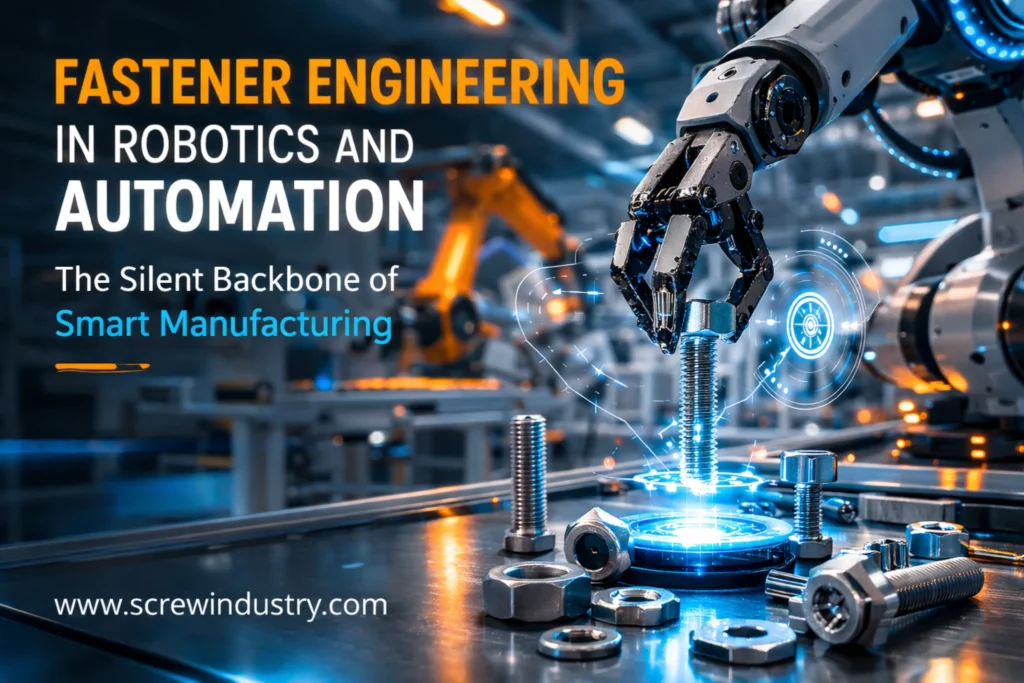
Fastener engineering in robotics and automation determines whether a production system holds its precision under dynamic loads — or gradually fails through joint loosening, misalignment, and unplanned downtime. In modern production facilities, algorithms, sensors, and software may be the brain of the system, but fasteners are its structural backbone.
The accuracy of a robotic arm, the reliability of an automated assembly line, and the continuity of high-speed manufacturing all depend on one essential factor: structural integrity. From robotic frames to automated conveyor systems, the right fastening solution directly affects precision, durability, vibration resistance, and long-term operational safety.
In robotics and industrial automation, fasteners are not simple hardware components. They are engineering-critical elements — and selecting the wrong one can compromise an entire system. To understand what makes a fastener suitable for demanding applications, it helps to first understand how industrial fasteners are manufactured and what production variables affect their performance.
Why Fastener Engineering Matters in Robotics and Automation
Robotic and automated systems are designed for continuous motion, repeatability, and high mechanical accuracy. These systems operate under dynamic loads, repetitive cycles, torque stress, and micro-vibrations. Even a small fastening failure can lead to misalignment, loss of calibration, production downtime, or costly maintenance.
That is why manufacturers, machine builders, and industrial engineers must choose fastening solutions that meet demanding performance standards in strength, tolerance, corrosion resistance, and dimensional reliability. Fastener engineering for robotics is not a procurement afterthought — it is a core design decision that influences every stage of machine operation.
1. Vibration Resistance and Fatigue Performance in Robotic Systems
Robotic applications require exceptional repeatability. In many systems, accuracy is measured in fractions of a millimeter. However, constant motion and repeated loading create long-term stress at connection points — and this is where fastener engineering decisions have the greatest impact on system performance.
High Strength Fasteners for Dynamic Loads
Fasteners in property class 10.9 and 12.9 are widely preferred in robotic chassis, machine frames, and high-load mechanical assemblies. These grades help prevent deformation under stress and maintain the rigidity required for stable movement and precise positioning. Property class requirements are defined by ISO 898-1, which specifies tensile strength, proof load, and hardness ranges for each grade.
For high-load robotic applications, high-strength bolts in grades 10.9 and 12.9 provide the combination of tensile strength and fatigue resistance required for continuous-motion systems.
DIN 912 Socket Head Cap Screws in Compact Designs
DIN 912 socket head cap screws are especially valuable in robotics because they provide high torque transfer in compact spaces. Their design allows engineers to build strong, space-efficient assemblies in robotic joints, brackets, actuator mounts, and machine enclosures. The DIN 912 standard is aligned with ISO 4762, ensuring dimensional consistency across international projects.
Key advantages:
- High torque capacity
- Strong clamping force
- Suitable for compact mechanical designs
- Reliable performance under repetitive movement
For robotics engineers specifying machine screws or hex bolts for structural frames and actuator assemblies, dimensional compliance with DIN and ISO standards is essential for interchangeability and reliable torque performance.
2. Material Science and Corrosion Control in Automation Lines
Industrial automation is not only about movement. It is also about operating reliably in demanding environments. Automated systems in food processing, pharmaceuticals, clean manufacturing, and automotive plants often face moisture, chemicals, washdown procedures, and temperature variation. In such environments, fastener engineering must account for material selection as carefully as for mechanical performance.
Stainless Steel Fasteners for Hygienic and Corrosive Environments
For industries where hygiene and chemical resistance are critical, stainless steel fasteners offer long-term security and lower maintenance needs.
- A2 stainless steel (304) — widely used for general corrosion resistance
- A4 stainless steel (316) — preferred for more aggressive environments with higher chemical exposure
Stainless steel fastener grades for corrosion resistance and mechanical properties are specified under ISO 3506. These materials are commonly used in:
- Food processing equipment
- Pharmaceutical automation systems
- Packaging machinery
- Cleanroom production lines
For food industry applications and marine or corrosive environments, A4 grade stainless steel offers the highest resistance to chlorides and chemical attack.
Surface Coatings for Extended Service Life
In applications exposed to humidity or outdoor conditions, protective coatings significantly improve fastener life and reduce corrosion risk. Common solutions include:
- Zinc plated fasteners
- Galvanized fasteners
- Other corrosion-resistant surface treatments depending on the application
Coating performance is validated by salt spray testing per ISO 9227. The right coating helps reduce maintenance intervals, prevent premature failure, and improve the reliability of automated systems operating in challenging environments.
3. Precision, Standards, and the Role of Fastener Intelligence
In advanced manufacturing, fastener engineering selection is no longer just a purchasing decision. It is part of the engineering process. Designers, procurement teams, and technical buyers need immediate access to dimensional standards, mechanical properties, material data, and application-specific options.
DIN and ISO Standard Compliance
Fasteners manufactured according to DIN and ISO standards provide consistency across global projects. Standardization improves:
- Interchangeability
- Assembly efficiency
- Maintenance speed
- Supply chain compatibility
For OEM manufacturers, machine builders, and exporters, standard-compliant fasteners are essential for quality assurance and international production requirements. The ISO/TC 2 Fasteners Committee coordinates the international standards framework governing dimensional tolerances, thread forms, and mechanical properties across the full range of industrial fasteners.
Engineering Data for Better Design Decisions
At Screwindustry.com, technical fastener data supports engineers from the earliest design stage. Access to detailed product specifications, standard dimensions, and material options helps reduce design errors, improve compatibility, and simplify sourcing decisions.
With a broad range of industrial fasteners and technical product information, engineering teams can select the right component faster and with greater confidence.
4. Fastener Engineering Decisions Directly Affect System Reliability
A robotic system is only as reliable as the components holding it together. Incorrect fastener engineering choices can cause:
- Joint loosening
- Loss of alignment
- Reduced vibration stability
- Increased wear on surrounding components
- Unplanned downtime in automation lines
Choosing the correct bolt, screw, nut, washer, or stainless fastening solution is not a minor detail. It is a key engineering decision that directly influences machine performance and production continuity.
Fastener Solutions for Robotics and Automation Applications
Below is a practical overview of fastening requirements in industrial automation and the recommended solutions.
| Engineering Requirement | Recommended Standard / Solution | Main Benefit |
|---|---|---|
| High-speed robotic movement | DIN 912, Class 12.9 | Vibration resistance and torque stability |
| Hygienic automation line | Stainless steel fasteners (A2 / A4) | Corrosion resistance and long service life |
| Outdoor or humid automation systems | Zinc plated or galvanized fasteners | Improved durability and lower maintenance |
| Compact mechanical assemblies | Socket head cap screws | High strength in limited installation space |
| Faster production assembly | Self-drilling screws | Reduced installation time and improved efficiency |
The Engineering Power Behind Smart Manufacturing
Programming a robot may be an art, but keeping it structurally reliable is pure fastener engineering. In high-performance automation, even one poorly selected fastener can compromise the stability of an entire system.
At Screwindustry, we believe fasteners are more than standard parts. They are essential engineering components that support the future of robotics, automation, and smart manufacturing.
As a fastener manufacturer and supplier focused on industrial performance, we provide reliable fastening solutions for demanding sectors where precision, durability, and consistency matter most. Our global logistics network serves engineering teams in 41+ countries with fast quotes and reliable delivery.
For a deeper understanding of how production quality affects fastener performance in demanding applications, see our guide: Bolt Manufacturing Quality: 9 Stages Every Buyer Should Understand.
FAQ — Fastener Engineering in Robotics and Automation
What are the best fasteners for robotics applications?
The best fasteners for robotics applications are typically high-strength bolts and precision screws that provide structural rigidity, vibration resistance, and reliable torque performance. DIN 912 socket head cap screws and property class 10.9 or 12.9 fasteners are commonly preferred in robotic systems.
Why are stainless steel fasteners used in automation systems?
Stainless steel fasteners are used in automation systems because they offer excellent corrosion resistance and long service life. They are especially suitable for food processing, pharmaceutical, and hygienic production environments. Grade selection follows ISO 3506.
What is the role of DIN 912 screws in robotics?
DIN 912 screws — aligned with ISO 4762 — are widely used in robotics because they provide high torque transfer, compact installation, and strong clamping force. They are ideal for robotic arms, brackets, actuator mounts, and machine assemblies.
How do fasteners affect automation line reliability?
Fasteners directly affect automation line reliability by maintaining alignment, structural stability, and resistance to dynamic loads. Poor fastener engineering decisions can lead to loosening, vibration issues, maintenance problems, and production downtime.
What should engineers consider when selecting fasteners for automation?
Engineers should consider strength class, material type, corrosion resistance, dimensional tolerance, surface coating, and compliance with DIN or ISO standards when selecting fasteners for automation systems. For procurement teams, understanding bolt manufacturing quality is equally important when evaluating supplier capability.