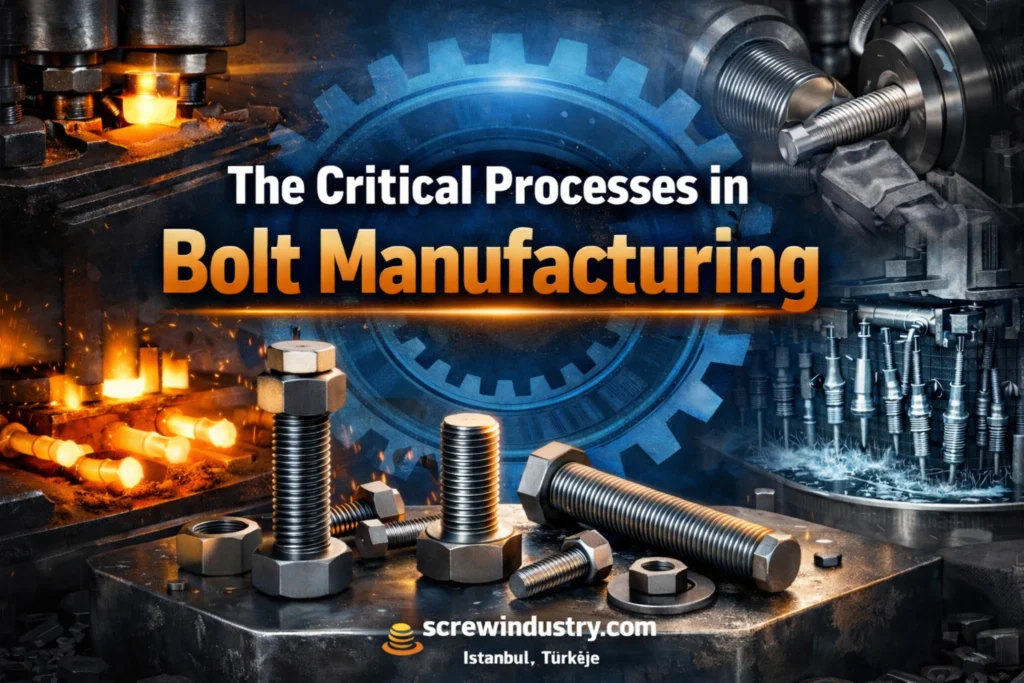
Bolt quality is not determined by a single operation—it is the result of a controlled, repeatable process sequence. At screwindustry.com in Istanbul, Turkiye, we see the same reality across industries: when manufacturing steps are changed, rushed, or poorly controlled, defects often appear later—sometimes only during assembly, torqueing, or real service conditions.
A typical bolt manufacturing flow looks like this:
- Wire rod / coil feeding
- Wire preparation and straightening
- Annealing (when required)
- Descaling / oxidation removal
- Cold heading (head forming)
- Heat treatment (for required strength classes)
- Thread rolling
- Surface treatment / coating
- Lubrication
- Sorting, inspection, and packaging
Below is a practical breakdown of the most critical stages—and what can go wrong if they are not controlled.
Cold Heading (Cold Forming)
Cold heading (also called cold forming or cold extrusion) is the main forming process for most standard bolts. Steel wire is fed into a multi-station header, where punches and dies apply high force at room temperature to form the bolt head and shape the shank.
Depending on the bolt design, cold heading may include:
- Forward extrusion
- Backward extrusion
- Composite extrusion
- Punching and trimming
- Cutting and sizing operations
- Calibration and sizing steps
Why cold heading is preferred
Cold heading is widely used because it offers:
- High material utilization (less waste than machining)
- High productivity (ideal for automation and mass production)
- Strong mechanical performance (grain flow follows the bolt geometry)
- Repeatable dimensions with stable tooling and process control
Common cold heading defects
If tooling or parameters are not stable, typical defects include:
- Head cracks, laps, or folds
- Underfill / overfill of the head
- Off-center heads or poor concentricity
- Burrs after trimming
- Dimensional variation (head height, across flats, underhead radius)
Key control points
- Wire quality and surface condition
- Die/punch wear and alignment
- Lubrication type and application rate
- Forming speed and reduction ratio
- Trimming quality and burr control
Heat Treatment
Bolts are commonly classified as ordinary bolts and high-strength bolts. In many standards, high-strength bolts typically refer to property classes ≥ 8.8 (and above). These are usually produced from low/medium carbon alloy steels (for example with boron, manganese, or chromium alloying) or high-quality carbon steels. After forming, they are typically hardened and tempered to achieve the required balance of strength and toughness.
Why heat treatment matters
Even if a bolt looks perfect after forming, incorrect heat treatment can cause failures later. Heat treatment directly impacts:
- Tensile strength and proof load
- Hardness distribution (surface and core)
- Toughness and brittleness risk
- Fatigue performance
- Dimensional stability (distortion control)
- Surface and coating performance after finishing
Common heat treatment problems (and typical causes)
- Insufficient hardness: incorrect austenitizing temperature/time or cooling speed
- Low tensile strength: poor hardenability, wrong tempering, inconsistent furnace uniformity
- Deformation/warping: improper loading, uneven heating, excessive quench severity
- Quench cracking: high residual stress, sharp geometry transitions, process mismatch
- Surface oxidation/decarburization: atmosphere control issues, poor sealing, wrong furnace conditions
Key control factors
- Steel chemistry and hardenability
- Heating temperature and soak time
- Quench medium and cooling rate consistency
- Part geometry (head-to-shank transitions)
- Furnace atmosphere and uniformity
- Residual stress control and process repeatability
Thread Rolling
Thread rolling forms threads by plastic deformation rather than cutting. Before rolling, the blank is prepared to the correct rolling diameter (commonly aligned to the pitch diameter target). During rolling, the blank is pressed between dies (flat dies or cylindrical dies) that imprint the thread profile as the blank rotates.
Why rolled threads are preferred
- Higher fatigue strength than cut threads
- Fast cycle times and high output
- Consistent pitch and good surface finish with correct setup
- No chips (cleaner, more efficient production)
Common thread rolling defects
- Thread flank scratches or surface cracks
- Incomplete thread fill
- Double-start or “disorderly” threads
- Pitch/lead errors caused by die wear or misalignment
Key control points
- Correct blank diameter
- Die condition, alignment, and wear management
- Feed stability and part handling
- Rolling pressure and speed
- In-process checking (go/no-go gauges, pitch checks, visual checks)
Surface Treatment (Coating and Corrosion Protection)
Carbon steel is one of the most common and economical bolt materials, but it has limited corrosion resistance without protection. Surface treatment is selected based on corrosion class, appearance, friction requirements, and service environment.
Common surface treatments include:
- Electro-galvanizing (zinc plating)
- Hot-dip galvanizing
- Phosphating
- Chromium plating (application-dependent)
- Cadmium plating (often restricted/regulated)
- Zinc flake coating systems
- Other application-specific coatings and passivation systems
Why surface treatment is critical
Surface finishing affects:
- Corrosion resistance performance
- Torque–tension behavior (important for clamp load consistency)
- Assembly performance (friction variation, galling risk)
- Appearance and customer specification compliance
- Compatibility with nuts, washers, and mating materials
Key control points
- Cleaning and activation quality (pre-treatment)
- Coating thickness consistency
- Process chemistry stability
- Post-treatment requirements (where applicable)
- Final lubrication (to control friction and assembly performance)
Inspection, Sorting, and Packaging
Even with stable processes, quality assurance is essential to prevent low-rate defects from reaching customers.
Typical controls include:
- Dimensional inspection (head, shank, thread)
- Mechanical testing (proof load, tensile, hardness) when required
- Surface/coating checks (thickness, adhesion, corrosion tests as specified)
- Sorting (manual or optical) to remove mixed parts or surface defects
- Packaging control (labeling, batch traceability, damage prevention)
Final Notes: Choose the Right Bolt for the Application
Choosing the correct bolt for the application prevents failures and unnecessary cost. When specifying bolts, consider:
- Required standard (DIN / ISO)
- Strength class / grade
- Environment (indoor, outdoor, marine, chemical exposure)
- Coating requirements and corrosion class
- Torque–tension expectations and lubrication needs
- Quality documentation and traceability expectations
If you want more technical fastener content and production guidance, keep exploring screwindustry.com.
Frequently Asked Questions (FAQ)
1) What is cold heading in bolt manufacturing?
Cold heading (cold forming) is a high-speed forming method where steel wire is plastically deformed at room temperature using punches and dies. It produces the bolt head and shank with excellent repeatability, high material efficiency, and improved mechanical performance because the metal grain flow follows the part geometry.
2) Why is heat treatment critical for high-strength bolts?
Heat treatment delivers the final mechanical properties (strength, hardness, and toughness). If temperature, time, or cooling rate are incorrect, bolts may suffer from low tensile strength, insufficient hardness, brittleness, distortion, or cracking—issues that might not be visible until assembly or service.
3) Why are rolled threads stronger than cut threads?
Rolled threads are formed by plastic deformation instead of cutting. This produces a smoother surface finish and favorable grain flow, typically improving fatigue strength and resistance to cracking compared to cut threads—especially in dynamic or vibration-loaded applications.
4) Which surface treatments are most common for carbon steel bolts?
Carbon steel bolts commonly use corrosion-protection coatings such as electro-galvanized (zinc plated), hot-dip galvanized, phosphated finishes, and zinc flake coating systems. The best choice depends on the environment (indoor/outdoor/marine), required corrosion resistance, and torque–tension/friction requirements.
5) What are the most common thread rolling defects in bolt production?
The most common issues are thread flank scratches, surface micro-cracks, incomplete thread fill, double-start or “disorderly” threads, and pitch/lead inaccuracies. These defects typically come from incorrect blank diameter, worn or misaligned dies, unstable feeding/orientation, improper rolling pressure, or poor lubrication and can reduce assembly quality and fatigue performance.
6) How does surface coating affect tightening torque and clamp load?
Coatings and topcoats (including final lubrication) change the friction at the thread and underhead bearing surface. Because torque is strongly influenced by friction, the same tightening torque can produce different clamp loads if coating thickness, surface roughness, or lubrication varies. That’s why consistent coating control and specifying torque–tension requirements are critical for reliable bolted joints.